Black & White in the Era of Colour
Cinema and photography are technical arts that emerged in the nineteenth century, but they truly came into their own in the twentieth. Historically we have grown used to admiring the uniqueness and singularity of the object depicted by an artist. With cinema and photography things stand somewhat differently. The philosopher Walter Benjamin argued that technical reproduction strips the image of its “aura” and replaces it with the effect of viewer shock. Shock is the foundation of this new technical art. This shock is akin to something military: suddenness, rhythm, the breaking of settled orders, the turning of the single into a multitude of fragments and, conversely, the assembling of unity out of the scattered (the effect of the crowd, the collage). Cinema and photography show not the uniqueness of the human being but the utmost degree of their solitude, not nature but the mass. Their instrument is the rhythmisation of disparate fragments. Eisenstein, Rodchenko and Vertov built their frames as a succession of “heavy mass-like bodies” – architectural, technical, human – shown as complex rhythmic unities. This is the rhythm of a mass advance of the visual upon the viewer.
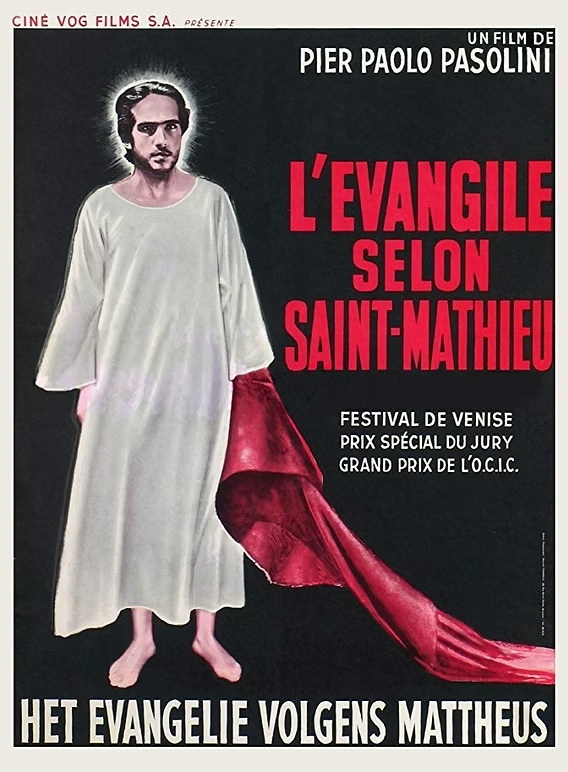
But there was another pole. As the philosopher Oleg Aronson said, countering Benjamin, “the aura becomes visible at the moment of its disappearance.” To see something and to feel its great value is possible only in the moment of loss. It was in this way that the very “radiance” of the aura came to be seen. The twentieth century was the time of the departure of the old aristocratic world. Yet it did not vanish entirely – it passed into cinema: into the cult of film stars, into a black-and-white splendour built on the effect of radiance. Black-and-white cinema became a space of admiration, of fairy tale, of reverie. It is a world where actresses look like living jewels, and colour – when it arrives – is perceived as the radiance of gemstones. It is no accident that the first film to win an award at Cannes specifically for colour was Ptushko’s The Stone Flower (1946), where colour was developed as the effect of a stone’s radiance – of ruby, emerald, diamond. With the arrival of colour, cinema drew closer to private life, became more “everyday.” It is colour that is associated with the “democratisation” of the language of cinema, the move away from the aristocratism of black-and-white images. But black-and-white itself did not disappear. In the era of colour cinema, black-and-white became a space of experiment, of sharpness, of authenticity. Colour “paints over” reality, while black-and-white reveals it, gives a sense of the chronicle, of the documentary, drawing out the element of chance, of the unstaged, as something aesthetically charged. And many directors of auteur cinema turn to black-and-white in their masterpieces, when they want to speak of their own sense of the real. Such films are made by German, Pasolini and Godard.
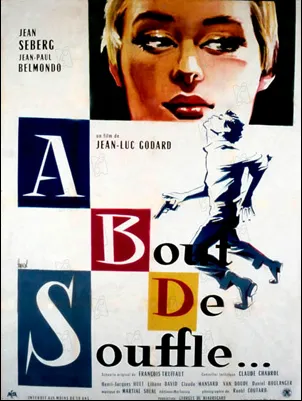
In Breathless, the camera almost becomes the body of the hero – running, falling in love, coming to awareness all happen here and now, as if in documentary footage. Yet this does not cancel out the artistic depth: the hero is at once a living immediacy and the embodiment of the great noir myth.